

Consider this one revealing truth: The vast majority of chronic diseases—type 2 diabetes, heart disease, autoimmune disorders, depression, Alzheimer’s, and many cancers—share a single underlying mechanism. Not a virus, not so-called bad genes, but chronic, low-grade inflammation.
Often not revealed by any symptoms, low-grade inflammation is driven by metabolic dysfunction. There is a failure of transformation at the deepest levels of your biology. A landmark review in the journal Nature Medicine called this “the most significant cause of death in the world today,” implicated in more than half of global deaths (Furman et al., 2019).
Ayurveda described this dysfunction centuries ago and gave it two names: impaired Agni — disrupted metabolic fire — and Ama, the toxic residue of what the body could not fully transform.
Let me show how a bridge can connect Ayurveda’s ancient map and modern medical science, leading to a practical way for reading the status of your own Agni right now.
What Agni actually is
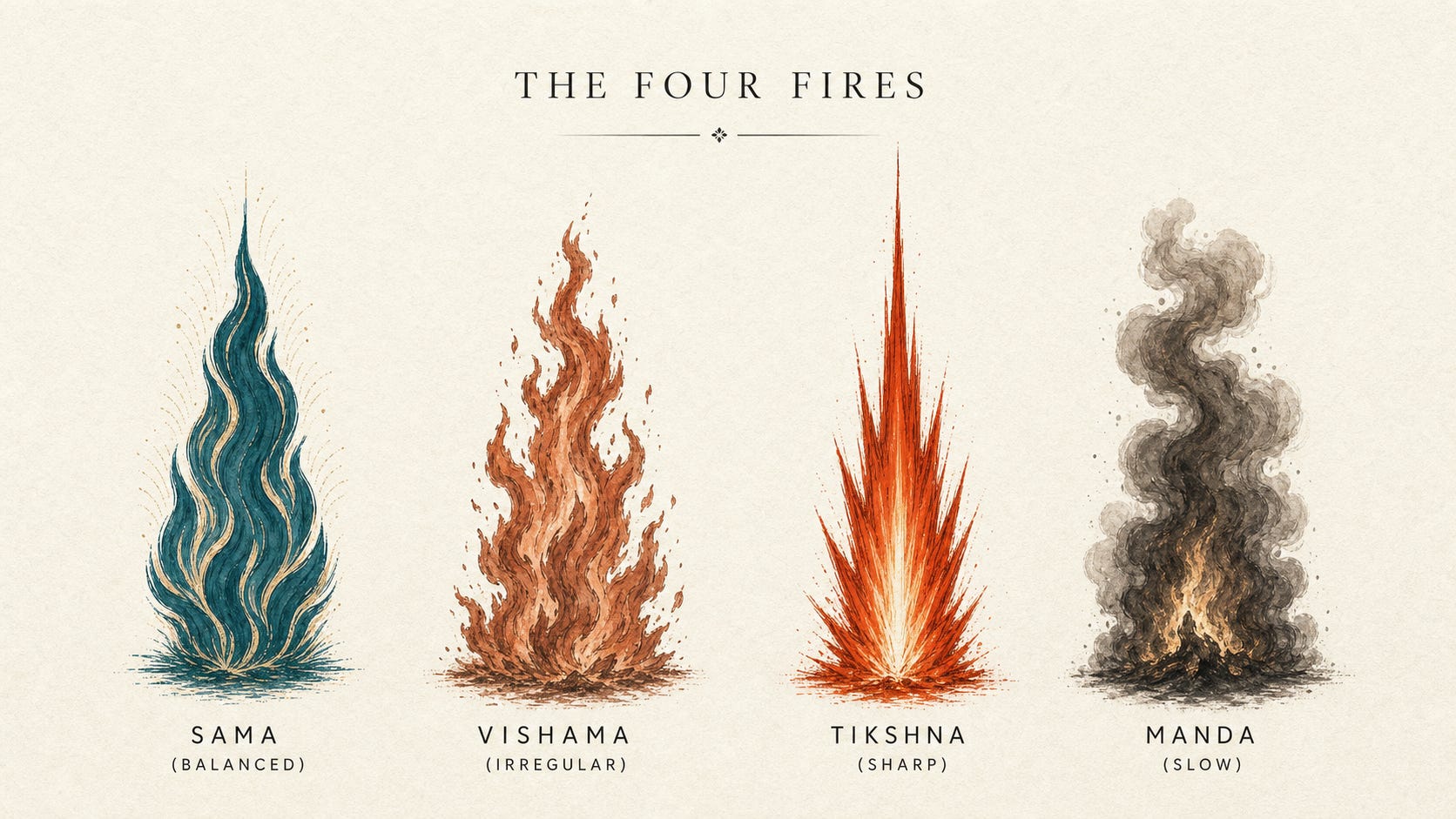
Agni literally means “fire,” but in Ayurveda it is more precise than a metaphor. Agni is the intelligence of transformation. It converts food, sensory input, emotion, and thought into tissue, energy, and clarity of mind — operating from the gut lining down to the mitochondria. When it burns cleanly, digestion is smooth, energy is steady, the mind is bright, and nothing important is left half-processed. Ayurveda names four states, each with a distinct signature:
· Sama Agni — balanced and efficient. Food digests cleanly, energy is steady, mood is even, the mind is clear.
· Vishama Agni — irregular and unstable. Digestion alternates between sharp and absent; bloating, gas, variable stools, a scattered, anxious mind.
· Tikshna Agni — overly sharp. Aggressive digestion, acidity, inflammation, hypoglycemia, irritability when hungry.
· Manda Agni — slow and heavy. Food lingers, weight climbs, congestion, sluggishness, brain fog.
Modern gastroenterology, endocrinology, and microbiome science have inadvertently mapped these same patterns in clinical language.
Agni in the gut: a living ecosystem
The closest contemporary analogue to Agni is your gut microbiome, roughly 38 trillion microorganisms living in dynamic partnership with you, turning food into nutrients as well as signaling molecules, which ultimately affects mood and cognition. When it is healthy, according to researchers, the microbiome produces short-chain fatty acids that nourish the gut lining, regulate immunity, and calms inflammation (Xiong et al., 2024). When the gut microbiome is disrupted, it is known as dysbiosis . In Ayurveda it is called disturbed Agni where the microbiome generates the molecular equivalent of toxic residue or Ama. The patterns line up precisely:
· Vishama Agni resembles the unstable, permeable gut of irritable bowel syndrome and small intestinal bacterial overgrowth.
· Tikshna Agni resembles the pro-inflammatory, low-diversity microbiomes linked to metabolic syndrome and fatty liver disease.
· Manda Agni resembles the dense, low-diversity microbiomes seen in obesity and type 2 diabetes — systems too heavy to change.
The findings extend into the mind: a 2025 Mendelian-randomization study across three large genomic databases found causal links between specific gut microbes and both depression and anxiety (Zhao et al., 2025).
Agni inside the cell: mitochondria
At the cellular level, Agni expresses itself through mitochondria, a structure inside the cell that turns glucose and oxygen into ATP, the energy currency of life. Mitochondrial dysfunction is now a recognized driver of aging, neurodegeneration, metabolic syndrome, and cancer (Miwa et al., 2024).
Ayurveda calls the brightness of a cell that burns cleanly tejas, so that mitochondria produces energy efficiently with minimal oxidative exhaust. When Agni fails, tejas dims. In modern physiological terms, membrane potential drops, reactive oxygen species rise, and cells slide toward senescence.
Ama: when transformation stalls
When Agni remains impaired, Ama accumulates, literally “unripe” or “uncooked” material that never finished its journey into nourishment or elimination. Today scientific investigation can measure several forms of it:
· Lipopolysaccharides (LPS): bacterial fragments that leak through a permeable intestine, bind immune receptors, and drive chronic inflammation across diabetes, heart disease, Alzheimer’s, depression, and obesity.
· Advanced glycation end-products (AGEs): “caramelized” proteins and fats formed when sugar metabolism runs wild. A 2025 review in Antioxidants tied them to type 2 diabetes, cardiovascular disease, neurodegeneration, and skin aging (Antioxidants, 2025).
· Reactive oxygen species (ROS): oxidative exhaust from inefficient mitochondrial metabolism, damaging DNA, proteins, and membranes.
· Senescent cells: metabolically exhausted cells that refuse to die and instead secrete inflammatory signals — the biology behind emerging senolytic therapies (Chaib et al., Nature Reviews, 2024).
These are the molecular biography of blocked transformation — Ama written in biochemistry.
Why this matters for how well you age
There is a modern name for the long-term consequence of blocked Agni: inflammaging. Prospective studies consistently show that adults with elevated hs-CRP or IL-6 in mid- and later life carry markedly higher risk of heart attack, stroke, dementia, cancer, and all-cause mortality — even after controlling for classic risk factors. Your metabolic fire is not just about digestion; it is a rate-limiting step for how gracefully your biology ages.
The practice, part one: reading your own fire
You do not need a lab. For seven days, after your largest meal, sit quietly for twenty minutes and ask:
· Do I feel clear, present, lightly energized? That is Sama Agni.
· Do I feel bloated, gassy, mentally scattered, as though the meal unsettled me? That is Vishama Agni.
· Do I feel hot, edgy, feverish, restlessly intense rather than relaxed? That is Tikshna Agni.
· Do I feel heavy, sleepy, cognitively slow, tipping from fullness into inertia? That is Manda Agni.
Most people see a pattern within days. Notice which foods, times of day, and emotional states shift it. You are learning the language of your own fire — the foundation of intelligent self-care.
The practice, part two: three evidence-backed ways to feed the fire
Three interventions have some of the strongest evidence in metabolic medicine — and each maps almost directly onto Ayurvedic instruction.
1. Eat with the sun. Ayurveda has long advised making the midday meal the largest. Modern science calls it circadian-aligned eating. In the 2024 TIMET trial, adults with metabolic syndrome who compressed eating to a 10-hour daytime window saw meaningful drops in HbA1c, cholesterol, and abdominal fat — comparable to intensive lifestyle programs (Manoogian et al., 2024); earlier windows outperform later ones for insulin sensitivity and inflammation (Xie et al., 2022).
2. Cook it well; keep it whole. Ayurveda favors warm, freshly prepared food cooked at moderate temperatures. Shifting from high-AGE cooking (dry, charred, high-heat) toward gentler wet-heat preparations reduces circulating AGEs, oxidative stress, insulin resistance, and TNF-α (Uribarri et al.).
3. Use your spice cabinet as medicine. A 2023 umbrella meta-analysis of ten meta-analyses (~5,870 participants) found curcumin significantly lowered CRP, IL-6, and TNF-α across many inflammatory conditions (Fadus et al., 2023); its CRP-lowering effect has been shown comparable to naproxen in rheumatoid arthritis (Nutrition Reviews, 2021).
Three quiet levers — when you eat, how you cook, what you season with — each moving the same needle Ayurveda has been pointing at for millennia.
From fire to essence: what Agni is building toward
Agni transforms food into tissue, but Ayurveda insists that is not the end of the story. Through a seven-stage refinement, the Sapta Dhatus, each tissue layer passes a subtler essence onward until, at the culmination, a rare substance emerges: Ojas — the reservoir of deep vitality, immunity, and resilience that may be the most important concept in longevity medicine that Western science has yet to name clearly.
· · ·
You are not a passive body waiting to be diagnosed. You are a living fire — an intelligence of transformation that has been refining itself moment by moment since the day you were born. That fire burns whether you attend to it or not. The choice is whether you feed it wisely.
Begin small. One meal, eaten earlier. One dish, cooked gently. One quiet moment of listening after you eat. That is metabolic self-literacy — Agni tended by attention — and that, quietly, is where a longer, brighter, more luminous life actually begins.
In the next article, we will follow the fire upward — from your plate to the finest layer of your biology — and see how tending Agni over time protects the very brightness of your life force.
Namaste,
Deepak