

As the numbers increase for older people with Alzheimer’s and other forms of dementia, the most painful question is whether the afflicted person is still here.
Neither of the usual answers quite fits. One answer, from a spiritual viewpoint, says that nothing is truly lost because the soul is untouched by what happens to the body. But this offers little emotional comfort to either the sufferers or their families. The other answer, taking a medical view of the damage brain, says that the person is gone, as if losing the story of a life proves that the one who lived the story has disappeared with it.
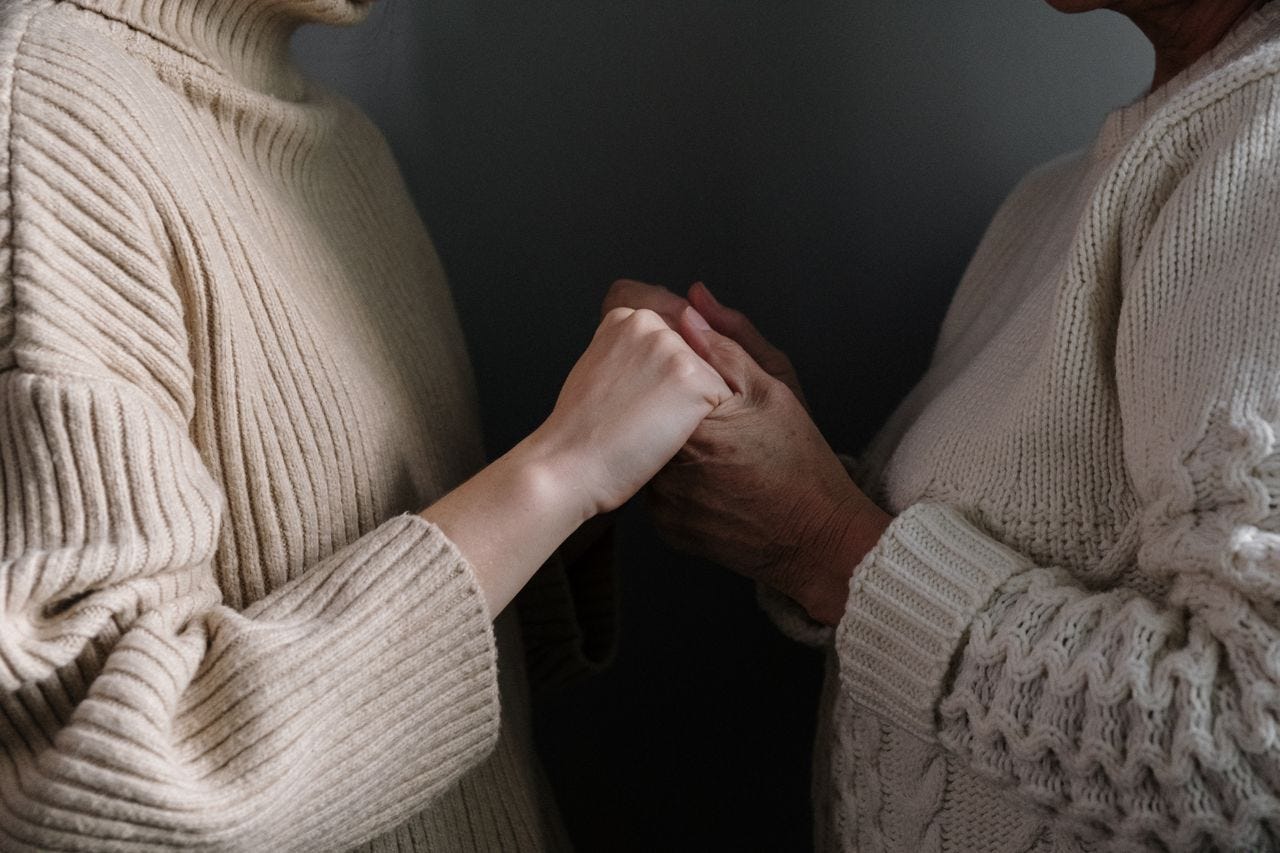
The nondual view offers another possibility: dementia profoundly changes memory, function, and relationships, while awareness remains the deeper reality even as the story of the self begins to fade.
What the disease takes away
As a brain disorder, Alzheimer’s disease damages neurons and the connections between them. It often affects memory systems early, disrupting the ability to organize experience into episodes: what happened, where, with whom, and in what order. As the disease progresses, it affects language, recognition, judgment, movement, and basic bodily functions.
Other dementias, including frontotemporal, vascular, and Lewy body dementias, begin differently and follow different courses. What they all share is a disruption of the capacities that help a person understand, navigate, and narrate a life.
The Vedanta tradition adds an important distinction to this description. What is being lost is smṛti, memory in its empirical sense: the person’s archive of events, names, and faces. What is not shown to be lost is chit, the knowing in which memory once appeared. Memory is content, while awareness is the condition in which content appears.
This distinction is a philosophical interpretation, not a laboratory finding. Neuroscience studies the neural conditions associated with memory, attention, perception, and conscious experience with increasing precision, but it has not settled the ultimate nature of consciousness.
The nondual view therefore does not compete with a neurologist’s examination or a brain scan. It asks a different question, not what the brain is doing, but who or what is knowing whatever the brain still allows to be known.
The self that was a story
Most people assume that their identity depends on continuity. I am the one who was born in a certain city, married a certain person, and remembers a certain afternoon. Take away the memories and, it seems, the self disappears.
The Māṇḍūkya Upaniṣad offers another perspective. Every night, in deep sleep, names and personal histories disappear. There is no biography, no career, no grievance, no opinion about the weather. And yet, upon waking, no one concludes that existence ceased during sleep.
The tradition speaks of turīya, the fourth, which is not another state alongside waking, dreaming, and dreamless sleep, but the underlying awareness of all three. Seen this way, the autobiographical self was always a construction, a narrative the mind tells continuously and with remarkable confidence, like a talk-show host who keeps talking because silence would be awkward. In dementia, the host loses the script.
That is a tragic loss of function and relationships, but the stage on which the host appeared was never the script.
What tends to remain
Caregivers often notice something that the word “gone” cannot explain. A woman who no longer recalls her daughter’s name still brightens when she enters the room. A man who cannot follow a conversation still sings a familiar song.
Every person and every stage of illness is different, but emotional tone, music, rhythm, touch, and familiar routines often remain meaningful after explicit recall has weakened. A person forgets the details of a visit yet retains, for a time, its comfort or distress.
In yogic psychology this is not surprising. Beneath explicit memory lie saṃskāras, impressions that shape disposition, tenderness, fear, and ease without requiring a story. And beneath the saṃskāras is the witness, sākṣī, awareness that does not depend on a remembered identity.
So when a daughter asks, “Does my mother know me?” there are two honest answers. Her mother might no longer know who her daughter is in the familiar autobiographical sense. Yet something in her could still respond to her daughter’s presence, just as the body recognizes warmth before a baby knows the word for it.
When spiritual insight becomes avoidance
Spiritual insight should deepen compassion, not distance people from suffering. Yet nondual language becomes a form of avoidance when it tells an exhausted caregiver that fatigue is an illusion or treats a patient’s agitation as the ego dissolving.
Dementia is not a graceful spiritual exercise. Confusion is frightening. Paranoia feels entirely real. Incontinence is not a teaching. A person who no longer recognizes home still experiences the terror of being lost there.
Nor is meditation a treatment for neurodegeneration. A healthy life, sleep, movement, social connection, and good medical care matter. But spiritual insight is not a cure, and no family should be made to feel that a loved one’s decline reflects insufficient awareness.
A practical caution belongs beside this spiritual one. Sudden confusion, a rapid change in behavior, new weakness, fever, a fall, severe pain, or an immediate safety risk calls for medical attention. Not every change is simply “the dementia.” Infection, medication effects, dehydration, delirium, and other treatable conditions worsen cognition or behavior. When something changes quickly, or someone is in danger, contact the person’s clinician or emergency services rather than trying to manage it through presence alone.
The nondual view regards the person as indestructible in a specific sense: What a person most fundamentally is cannot be reduced to a quantity of stored information. This is a form of consolation grounded in a different understanding of identity.
The caregiver’s practice
The deepest teaching of these disorders falls not on the patient but on those who love them. The caregiver is asked daily to relate to someone without the support of shared history. The usual shorthand—remember when, you always, you promised—no longer make a connection. What remains is the present moment, stripped of narrative.
This is exactly what contemplative traditions spend decades trying to cultivate, and here it arrives without invitation and without mercy. Nobody should romanticize that, but there is a possible opening. When the story can no longer carry the relationship, presence must.
You stop relating only to who she was and begin, as best you can, to be with who is here: a face, a hand, a moment of recognition that does not need a name.
The Sanskrit word for recognition in Kashmir Shaivism is pratyabhijñā, re-cognition, knowing again what was never absent. In the presence of dementia, it is the caregiver who is invited to remember, not the past but the one who is present beneath appearances.
You can grieve the story and still sit with the one in whom the story was told.
Daily Offering: Presence Without a Name
This practice is for caregivers, family members, and anyone sitting with someone whose memory is fading. It takes a few minutes and can be done at the bedside or anywhere.
Arrive. Sit near the person, or bring them to mind. Feel your own breath for three slow cycles. Let your shoulders relax.
Release the script. Silently set aside what you hope the person will remember today. You are not here to be recognized. You are here to be present.
Meet the senses. Notice one simple thing you share: the light in the room, the sound of breathing, the warmth of a hand if touch is welcome. Let that be the whole conversation.
Recognize the knowing. Notice that you are aware of all this. Then consider, without needing to prove it, that awareness is also present in the other person, however differently it is now expressed.
Honor what is hard. If grief, frustration, or fatigue arises, acknowledge it. Awareness does not require you to feel peaceful. It asks only that you be honest.
Close gently. Offer a silent phrase, such as: “Beneath what we have lost, we are still meeting.”
If caregiving is overwhelming, that is not a failure of practice. Reach for help, rest, and the support of others. Presence is easier to offer when someone is also offering it to you.
Namaste,
Deepak
**********************************************************************
If you would like to explore this subject further, I invite you to visit DeepakChopra.ai.

──────────────────────────
Deepak’s latest book, Awakening in the Final Chapter, is available as hardcover, ebook, and audiobook.