

In 2008, researchers at Harvard drew blood from long-term meditators, then compared their gene expression profiles to healthy controls. The finding was striking. In the meditators, 2,209 genes were expressed differently, most of them in networks that govern inflammation, energy metabolism, and the cellular stress response (Dusek et al., PLOS ONE, 2008).
A follow-up study in 2013 showed that even a single intensive day of meditation was enough to change the expression of inflammatory and epigenetic genes (Kaliman et al., Psychoneuroendocrinology, 2014). Not months of practice. One day. What all of these practices share, whether silent or voiced, is a rhythmic act of attention that the body reads as safety. And of all the forms this act can take, the human voice may be the most direct.
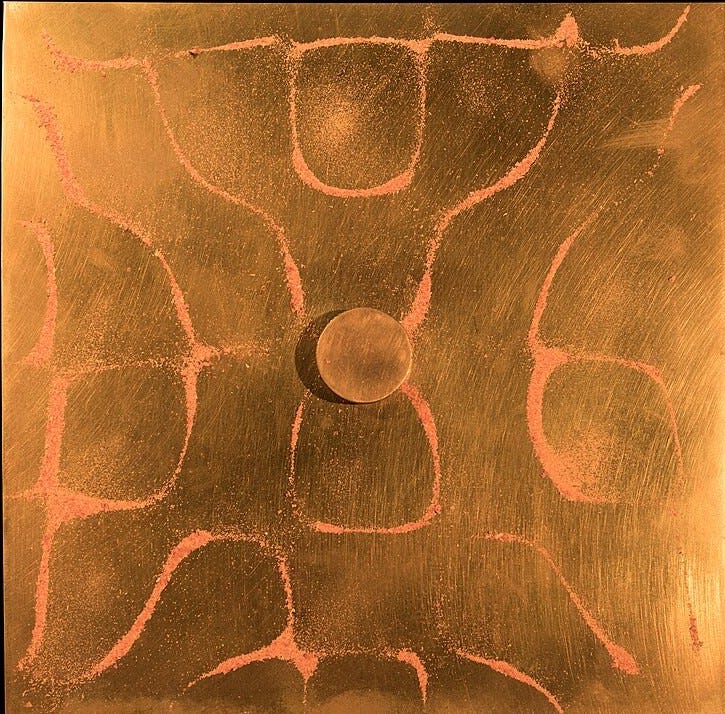
Shabda: the first tanmatra
In the Vedic map of experience, the world condenses out of subtle qualities called tanmatras. Sound, or Shabda, is the first of them. Touch, sight, taste, and smell arrive afterward. In this working model of reality, as in quantum theory, vibration is the substrate from which matter is composed, and the human nervous system is tuned to that substrate.
A thought “in here” is vibrationally connected to a physical result “out there.” Two worlds, mind and matter, are bridged every time you form a sound. The ancient practice of chanting a mantra was applied acoustics for the human being.
Your nervous system was tuned to sound before it was tuned to almost anything else. In infancy, before you understood a word your mother spoke, you knew when you were safe by the pitch and cadence of her voice. Your adult nervous system is still listening today.
Your nervous system is listening
Perhaps the clearest bridge between the Vedic teaching and modern science is Stephen Porges’s Polyvagal Theory. It centers on the hidden benefits derived from the state of a single cranial nerve, the vagus nerve, which emerges from the brain and reaches the heart, lungs, abdomen, and beyond.
Porges identified a specific band of acoustic frequencies, roughly 200 to 500 hertz, that the human ear and brainstem read as a signal of safety (Porges, Cleveland Clinic Journal of Medicine, 2009). This is the range of a warm human voice, of humming, and of chanting. Frequencies in this range engage the ventral vagal complex and shift the body out of defense into an open, receptive, healing state.
Why does this matter for your health? Because the state your nervous system spends most of its time in is a metabolic setting. In a defensive state your body diverts resources to survival. Blood pressure rises, digestion slows, immune cells stand down from routine maintenance, inflammation climbs, and repair work is postponed.
When the body shifts into the ventral vagal state, however, it resumes what it was designed to do at rest. Heart rate variability rises. Digestion and immunity come back online. Tissues get a chance to repair themselves.
Every hour you spend in the healing state is time your body is actually healing. Every hour you spend in low-grade defense mode is time it is not healing. Chronic disease, at the biological level, is largely the story of a nervous system that has forgotten how to come home.
Sound is one of the fastest known ways to invite it back.
Humming as pharmacology
In 2002, two researchers at the Karolinska Institute reported that humming increased the nitric oxide in nasal exhaled air fifteenfold compared with silent breathing (Weitzberg and Lundberg, American Journal of Respiratory and Critical Care Medicine, 2002). Nitric oxide is a vasodilator, a bronchodilator, an antiviral agent, and a signaling molecule so important that its discovery earned the 1998 Nobel Prize in Physiology or Medicine.
This means that every time a practitioner slowly drew out the long “mmm” of AUM through the nose, they were dosing themselves with a therapy whose active ingredient would take thousands of years to name scientifically.
Bija mantras and the doshas
Ayurveda goes further and matches specific seed syllables, or bija mantras, to specific constitutions described via the three doshas.
For Vata, the restless and airy dosha, the syllable Aim is clarifying and grounding. It gathers the scattered mind and gives the breath something steady to rest on.
For Pitta, the sharp and fiery dosha, the syllable Shrim is cooling and centering. It softens the edge without dulling the intelligence.
For Kapha, the heavy and slow to change dosha, the syllable Hum is penetrating and stimulating. It stirs the system awake.
You do not need to believe in any of this to test it. Sit quietly. Intone one syllable at a time on the exhale for a few minutes. Notice any subtle changes in the body, the breath, and the mind. That noticing is qualia medicine. The lab result is your own experience, and it is available whenever you sit down.
Sound in clinical settings
Hospitals have begun to catch up. Therapeutic singing programs are showing reductions in post-operative anxiety and pain. In group chanting studies with cardiovascular patients, heart rate and respiratory rhythms synchronize across the participants, a measurable coherence linked to better immune function (Bernardi et al., BMJ, 2001). A roomful of people breathing and vocalizing together briefly becomes one therapeutic instrument. Something in the biology recognizes what is happening and moves toward it.
A morning mantra protocol
Sit comfortably. Begin with a long, quiet “mmm” on the exhale, feeling the vibration in the chest, throat, and skull. Do this for five to seven breaths, or for as long as feels natural. Then move to So-Hum, silently receiving “So” on the inhale and releasing “Hum” on the exhale, for ten to fifteen minutes.
Notice your nervous system before you start and again when you finish. That comparison is the whole practice. You are letting the body remember what it already knows.
The receiver is already tuned
Sound moves through the body and is received by a nervous system already tuned to hear it. There are 107 specific points on the body where reception is amplified, and where the concentration of what Ayurveda calls pranic intelligence is measurably higher. In the next article, we enter the world of Marma, the biofield map, to discover what its most vital points correspond to in the nervous system, in areas that modern anatomy is still mapping.
Until then, hum. The pharmacy is inside you, and it opens the moment you exhale.
Namaste,
Deepak
Deepak’s latest book, Awakening in the Final Chapter is available for pre-order now and publishes September 8. Reserve your copy today so it arrives the moment it’s released.