

There is a question I keep returning to that hides inside every other question. Philosophers circle around it. Science dismisses it as unscientific. But it has been asked since the oldest wisdom traditions, and I want to make it personally relevant today.
Here is the question: What is the ground of our own being? Is it the self of the individual, or is there a cosmic, universal Self?
What the question already concedes
Even modern science concedes that there is something, call it awareness, being, or consciousness, without which we would not be able to think or perceive anything. Scientific validation is not as important as everyone’s firsthand experience of awareness as the most basic state of being human. Awareness is in the background of every thought, just as the light in a room lies behind the objects the room contains.
Awareness, being ever-present, is merged with the individual self. Yet we are in the habit of feeling separate. As soon as we say, “Let’s examine reality,” we have set the examiner apart from the thing being examined. This separation, or duality, comes so naturally that it is hard to defy.
The individual self cannot cross this gap between duality and wholeness. The rational mind is a surveyor, drawing borders wherever it looks. Send it to measure the borderless, and it returns with no map at all.
A different kind of knowing
Every tradition that has taken this gap seriously has arrived at the same suspicion: that reality is hidden from everyday sight, and yet it must be present. The Upanishads call this pratyabhijñā, recognition, the sudden noticing of what was never absent. In modern times Ramana Maharshi pointed to it as the collapse of the “I-thought” into its source.
In his third Yoga Sūtra, the ancient sage Patañjali describes what happens as tadā draṣṭuḥ svarūpe’vasthānam, the Seer abides in its own nature.
That nature is the universal Self, which is borderless, formless, and infinite. This Self does not need to seek a way out of duality, because it is already whole. You do not learn about the universal Self the way you learn things in school. You merely cease to overlook it. The knower, in its purity, is what you were looking for all along.
Three doorways that actually work
The Indian traditions offer three doorways to noticing the ground of being in the Self. These are ways of thinning the veil of habitual overlooking.
The first is the way of the witness. It pares down appearances until awareness stands in the foreground, uncluttered. You sit and notice what awareness is not, known in Sanskrit as neti, neti, meaning “not this, not that.” Not the body, the breath, or thoughts, all of which arise and pass away. Not even the witness as a located watcher, because it too is a subtle object. Subtract everything you are not, and what remains is pure awareness, needing nothing outside itself.
The second way is a threshold between the individual mind and awareness. The Vijñāna Bhairava Tantra offers 112 of these. The ones that work most reliably are the seams of ordinary experience: kumbhaka, the natural pause between the out-breath and the in-breath, or the half-second when a song you love ends and the silence has not yet arrived. In such moments, form thins and the formless is briefly revealed.
The third way is devotion, wonder, and aesthetic shock. An intense experience of beauty, love, or awe collapses the subject-object duality without argument. A piece of music that undoes you. The dignity of great old age. The way a child laughs in the next room. In such moments the “I” briefly forgets to defend itself, and the ground of Being shines through the opening.
The paradox of finding Reality
Although the three doorways are easily described, the seeker faces a paradox. How can you test what is real when, by definition, any test falls short of pure Being, and yet pure Being is what you are after? If the Real is the ground of every test, then testing it is circular.
Whatever can be tested is not it, because tests are looking for an object. Whoever is doing the testing is it, because the observer and the observed are aspects of the same wholeness.
This is illustrated by the futility of looking for awareness in the brain. Neuroscience can map brain activity with more and more precision, but that activity is the fingerprint of awareness, not awareness itself. Brain maps presuppose a mapmaker who is never found on the map.
A short practice
Words can only walk you to the door. Read this slowly, then close your eyes and let it happen.
Find a comfortable seat. Take three slow breaths, only to arrive.
Feel the body’s weight, its temperature, the places it touches the chair. The body appears to you. Ask, gently: to whom does the body appear? Do not answer with a thought. Let the question rest.
Notice the breath. It arises and passes in something that does not. To whom does the breath appear?
Watch a thought arise, then pass. Watch the small space between two thoughts. They come, they go, and something remains. To whom do thoughts appear?
Now notice that even the watcher is itself something noticed. What is aware of the observer?
Here something interesting happens. There is no next thing to point to. The pointing collapses into itself. The knower and the known fold into a single presence that has no edge, no location, no shape. You cannot find it, because it is what is looking.
Resting in simple awareness is what remains when the person, the individual self, is no longer being manufactured. This untouched and untouchable awareness has been present in every moment of your life. It went unnoticed only because it has never left.
So, how can we know fundamental reality?
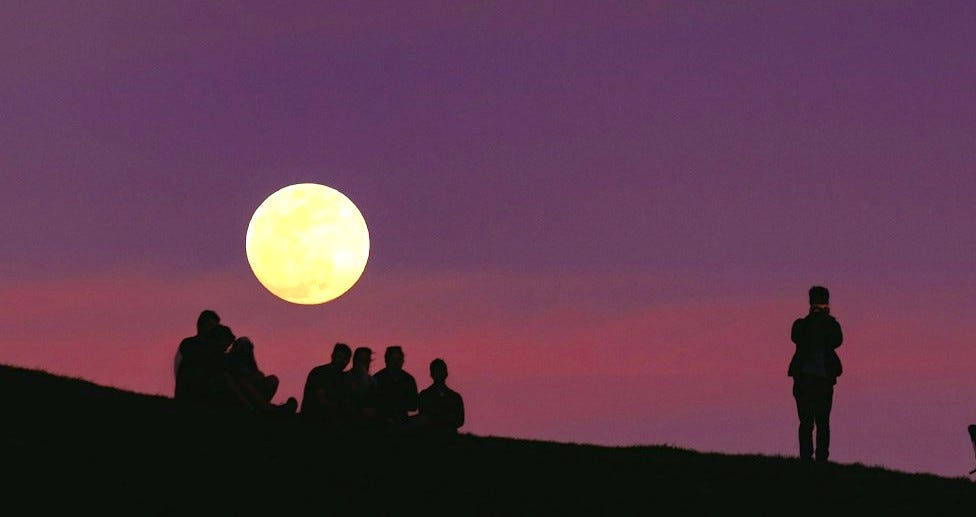
By noticing the only thing that has always been there. The universal Self is known through nonseparation. You are what you have been trying to find. Every path, every practice, every explanation is a finger pointing at the moon that is already shining.
May you recognize, today, what has always recognized you.
Namaste,
Deepak
Deepak’s latest book, Awakening in the Final Chapter is available for pre-order now and publishes September 8. Reserve your copy today so it arrives the moment it’s released.