

The nervous system meets the world through the five senses, and today I want to consider the sense of touch. Press one or two fingertips lightly at the midpoint between your eyebrows. Stay there for half a minute and let the breath become slower without forcing it. Many people notice a settling behind the eyes, a pause in the rush of thought, or a fuller exhale.
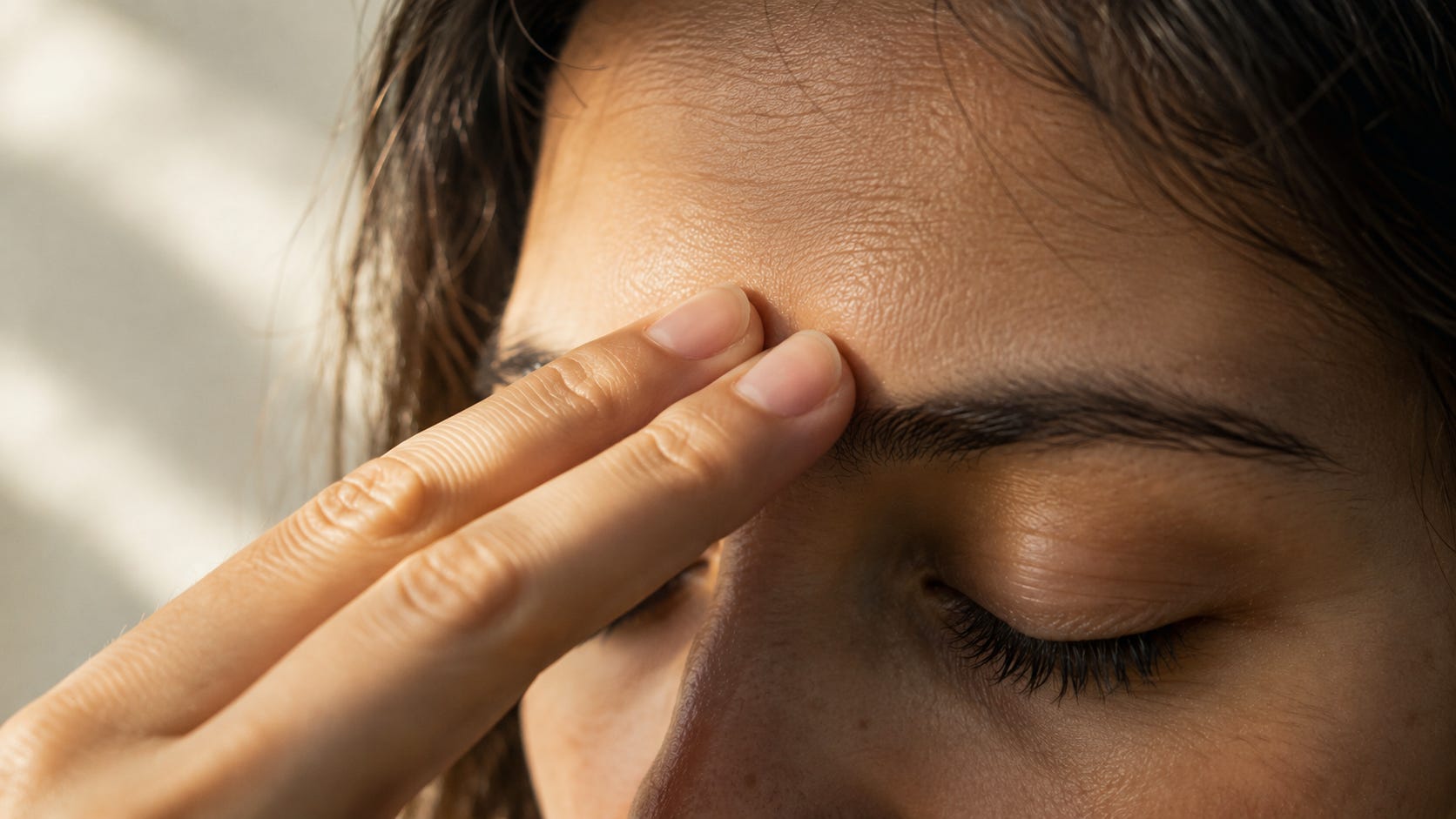
Ayurveda calls this place Sthapani Marma, often translated as the third-eye point. In the classical Ayurvedic map, the body contains 107 marma points, places where muscles, blood vessels, tendons, bones, joints, and nerves meet in subtle but vital ways.
Marmas weren’t treated as random dots on the skin. They were understood as places where the body’s organizing intelligence could be reached with care. Comparative study on marma and acupoints
Today, anatomical findings give us another language for the same understanding. Many marma points lie near important nerve pathways, sensory-rich tissue, vascular junctions, and the networks that link the brain to the heart, lungs, gut, and skin.
The ancient Ayurvedic map does not need to compete with the new one. It invites us to explore a truth that is available in our own experience: the body is constantly monitoring the quality of touch.
The places where the body listens
The Sanskrit word marma carries the sense of a hidden or vital point. Early Ayurvedic physicians recognized that certain areas of the body held special significance. Injury there could be serious. Careful attention there could support balance, circulation, comfort, and restoration.
Modern researchers are still working out how closely individual marma points can be matched to specific anatomical structures. Broad claims that all 107 points correspond exactly, one for one, to named autonomic plexuses or receptor clusters go beyond what science has conclusively established. Yet the central observation remains compelling: marma points are often located where several systems meet, including nerves, connective tissue, blood vessels, muscles, and joints. Synergistic Mapping of Marmas: An Anatomical–..
That is what makes them personally interesting. A marma is an invitation to bring awareness to a place where the body may be especially responsive. The evidence is partly scientific, partly traditional, and partly experiential. You can place a hand on your chest, feel your breathing change, and recognize that your own body has become the laboratory.
Your hands speak to your nervous system
We tend to think of touch as a local event. A hand touches a shoulder. A thumb presses the sole of a foot. Yet these local messages travel far beyond the skin.
Scientists have identified C-tactile afferents, a class of slow, unmyelinated sensory nerve fibers especially responsive to warm, caress-like stroking. Their activity tracks the pleasantness people report during slow touch, and brain imaging research links this kind of input to the posterior insula, a region involved in the felt condition of the body.
This helps explain why a caring hand on the arm, a foot massage at the end of a difficult day, or the ordinary comfort of holding someone close can affect more than mood. The nervous system receives a message about safety and connection. When that message is credible, the breath may lengthen, muscular guarding can ease, and the body has more room for digestion, immune maintenance, and repair.
Ayurveda would say that Prana, the life energy moving through us, has been invited to flow more harmoniously. Neuroscience describes sensory pathways, autonomic regulation, and interoception. Both descriptions point toward the same lived fact: our bodies respond to attention that is patient, warm, and present.
Three places to begin
The full marma map is traditionally studied with trained practitioners. For a home practice, there is no need to make touch forceful or complicated. The following three points offer a safe way to learn from direct experience.
Sthapani Marma: the space between the eyebrows
Place the pad of your middle finger at the midpoint between the eyebrows. Use light, steady contact for 30 seconds while breathing slowly. Do not press hard. Let the eyes relax and notice whether the forehead, jaw, breath, or stream of thoughts changes.
This is not a medical treatment for anxiety, insomnia, or any other condition. It is a short experiment in attention. For many of us, the front of the face carries the residue of effort. A pause here can help the whole system recognize that it does not have to keep pushing.
Hridaya Marma: the heart center
Place both palms over the center of your chest, at the sternum. Take five unhurried breaths. Feel the warmth of your hands and the movement of the rib cage beneath them.
The heart is surrounded by a rich network of nerves, including the cardiac plexus, and its rhythm is in continual conversation with the brain through the autonomic nervous system. Your hands cannot directly manipulate that network. They can offer the sensory conditions in which breathing slows and the body may shift toward rest. A hand over the heart is one of the oldest human gestures of reassurance for good reason.
Talahridaya Marma: the center of the sole
Before bed, warm a few drops of sesame oil between your hands. Massage the center of the sole of each foot with your thumb for about two minutes, using a comfortable circular motion. The feet are dense with sensory receptors and constantly report information about pressure, balance, texture, and movement to the brain.
This practice gives the day a physical ending. We spend hours standing, walking, and carrying ourselves forward. Touching the soles of the feet is one way of telling the body that it can set down its work.
One important boundary
The neck requires special respect. The carotid sinus, near the upper part of the neck, contains pressure sensors involved in blood-pressure regulation. In clinical settings, trained clinicians may massage this area for specific diagnostic purposes. It is not advised as a self-care marma practice, however. Carotid sinus massage can trigger dangerous changes in heart rhythm or blood flow and has clear medical contraindications, including recent stroke, transient ischemic attack, or heart attack.
The deeper principle of marma care is not force. It is responsiveness. If touch causes pain, dizziness, palpitations, numbness, or distress, stop. For persistent symptoms, the appropriate next step is to seek medical care. Clinical carotid sinus massage is reserved for appropriately screened and monitored contexts.
The intelligence beneath your hands
We live in a culture that often meets the body only when something goes wrong. Ayurveda offers a more intimate relationship. It asks us to meet the body daily, before distress becomes the only signal we can hear.
Place your hand between the eyebrows. Place both hands over your heart. Massage the soles of your feet before sleep. Then notice. Has the breath changed? Has the jaw let go? Is the mind less crowded? Does sleep arrive with more ease?
That noticing is qualia medicine. It honors scientific inquiry, while also recognizing that consciousness is where health is finally felt. The body’s intelligence network is already here, beneath your own hands, waiting for a few minutes of sincere attention.
In the next article, we will enter Rasayana, Ayurveda’s science of rejuvenation, and explore what modern research is discovering about herbs, cellular repair, resilience, and the possibility of rebuilding from within.
Namaste,
Deepak
Deepak’s latest book, Awakening in the Final Chapter is available for pre-order now and publishes September 8. Reserve your copy today so it arrives the moment it’s released.